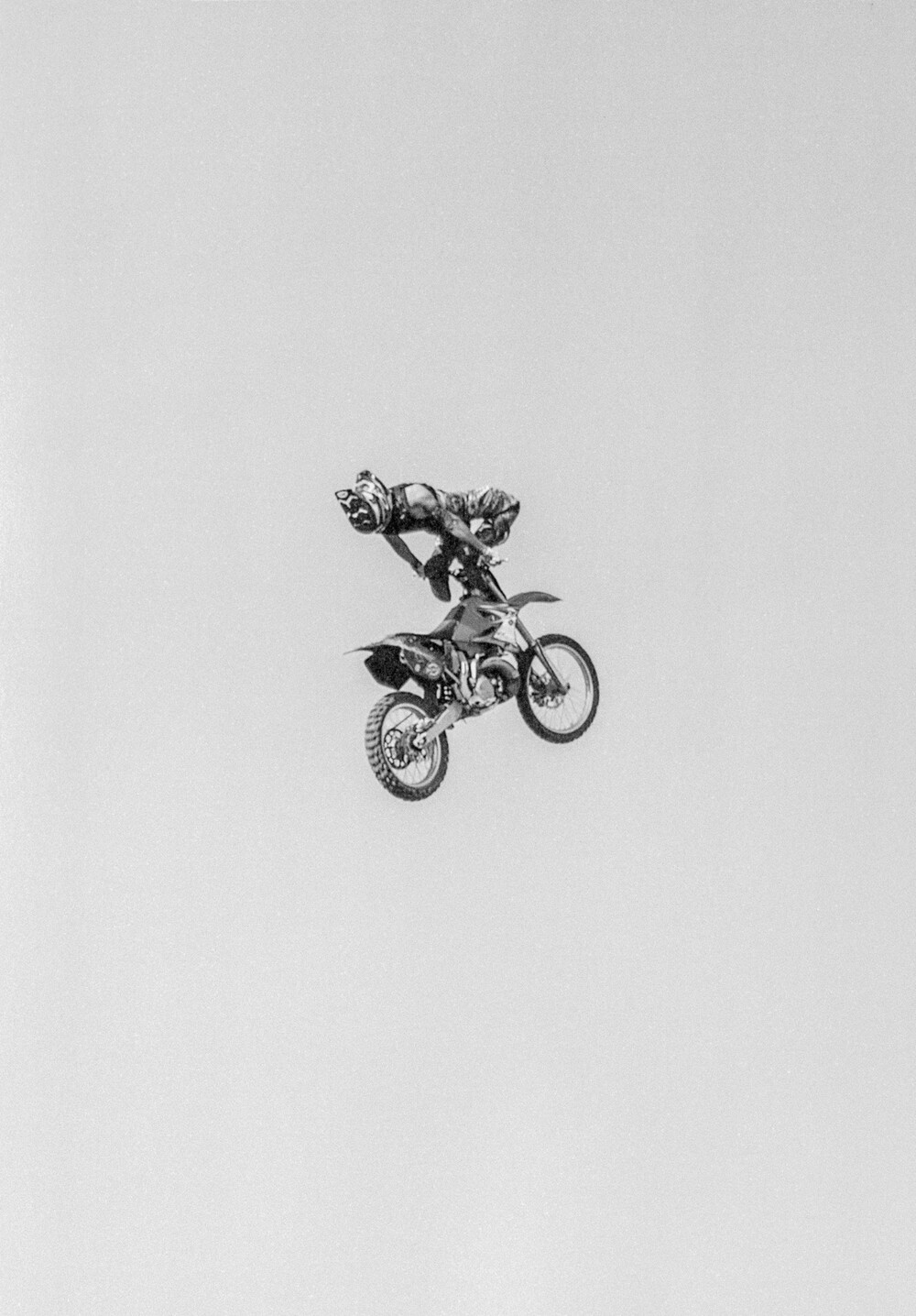
I decided to make a portrait on Pierre, 22 years old, son of a winegrower, forced to take over the vineyards and practicing motorcycle-freestyle as an outlet. We had a different upbringing and this is also what interested me about him. He grew up in the country learning everything by himself while I, coming from the city, was in constant admiration of him and I was waiting to be taught things. The question of transmission and the father/son relationship arises. He was always told that he would be a winemaker later on and it always frustrated him deeply not to be able to do something else as a profession. I wanted to approach the notion of virility through the aspect of motorcycle-freestyle. Manhood is an ideal. An ideal of perfection, performance and courage, which is demonstrated as much by physical as by verbal demonstrations of authority and power. Manliness is the bearer of an imaginary that fascinates by its way of pushing to the limits certain qualities expected of a man. Pierre struggled to find an outlet for his frustration. This outlet is FMX, a motorcycle sport where everything happens in the air in the space of 3 seconds. This world, which is actually little known and full of clichés, is seen as a world where the freestyler is a superman, full of testosterone, embodying the image of the alpha male. Looking to impress the gallery, to be the strongest compared to the other competitors. Pierre practices this sport in the opposite way of these clichés. He seeks in this sport an escape, to get out of his daily life by flying and trying to go higher and further and to stay in the air as long as possible. It is also a need to prove to himself that he exists. Pierre rides his motorcycle on a piece of land that he owns. He bought it from his father so that it would become his playground and he would not owe anything to anyone.

I don’t have friends,
I got family.

Driving is a spectacular form of amnesia. Everything is to be discovered, everything to be obliterated.

I’d rather cry in a Jaguar than on a bus
5 Seconds of Ecstasy
ByAchille Laplante - Le Brun
Achille Laplante Le Brun
Achille Laplante Le Brun, Orsola Valenti, Marco Poloni
Malter, Achille Laplante Le Brun
Achille Laplante Le Brun
Pierre Chidaine
Antonio Mouralinho, Robert Dutoit, Armand Yeli
Pierre Chidaine, Adélaïde Plancoulaine, Michèle Le Brun, Corentin Raux, Romane Pilorget, Mathias Muller, Jeanne Le Brun, Suzanne Laplante, Bertrand Deslandes, Marco Poloni, Orsola Valenti, Clément Lambelet, Milo Keller, Olivia Schenker, Elisa Ribeiro
I also wanted to address the issue of masculinity through the father/son relationship, but especially that of Pierre and I by showing a fusional brotherly relationship. Our relationship is different from the one we are used to seeing in the movies, today we cannot imagine a purely friendly relationship when we see 2 men very close socially through the cinematic culture. In the films Matthias and Maxime by Xavier Dolan, Brokeback Mountain by Ang Lee or Summer ’85 by François Ozon, the relationship between 2 men is in the foreground and it is homosexual. Masculinity is a set of attributes, behaviors and roles associated with boys and men. However, masculinity must be distinguished from the definition of male biological sex. These two notions are to be well differentiated and distinguished. One is not synonymous with the other. 3 levels allow to “determine” the masculinity of a man. The first level is personal, that is to say, how the person is physically. Then the situational level is the geographical point of view of the person. And the contextual level of the person, that is, the social environment in which he lives. As a result, 4 kinds of masculinities are possible. Hegemonic, complicit, subordinate and marginalized masculinities. Hegemonic masculinity is not a fixed and unchanging personality type, but the masculinity that is in a hegemonic position in a given structure of gender relations, a position always subject to challenge. Subordinate masculinities are dominated and posed as a counter-model, complicit masculinities support it because they benefit from patriarchy, and marginalized masculinities are those of dominated ethnic and social groups that can embody a model of hegemonic masculinity without engendering social authority in the group from which they come.

My goal is not to determine the masculinity of a person nor to have any judgment but to show the complexity of masculinity. The determination of Pierre’s masculinity is done by 3 levels. First, the personal level, Pierre is 22 years old, heterosexual, white, passionate about motorcycles and extreme sports. He is a person who has the heart on the hand by taking care of his close relations. Then we move to the situational level, Pierre is from a French countryside constantly connected to nature and surrounded by the world of wine growing. Then the contextual level, i.e. social. Pierre is in a family of winegrowers, being the only son, he is predestined to inherit the family estate and he is aware of it since he was a child. This is something that preoccupies him because for a long time he tried to avoid this obligation and to look for something else to do. He quickly found an outlet in motocross which is a team sport, where competition is very present and then he switched to FMX which is a much more solitary freestyle motorcycle sport. In the idea where the desire to feel alive, it seems important to me to take into account the notion of vulnerability. The biker needs to feel his existence through a moral and physical fragility. Because the risk is so intense and present that the demands he must make of himself must be greater than this fragility that is present. In this notion of vulnerability, it is also important to take into account the attachment to the soil, to his native land where Pierre here is attached to this land and this ends up eating away at him little by little.
